 TechBaton
AI Strategy & Architecture
Roadmaps, feasibility, and architecture that align AI with business goals.
The problem
Many organizations feel pressure to "do something with AI" but struggle to decide where to start, how much to invest, and what is actually feasible in their environment. Industry research consistently shows that AI initiatives fail more often due to vague goals, fragmented data, and organizational constraints than because of the underlying technology.
Ideas get stuck at the proof-of-concept stage, pilots run in isolation from core processes, and technical choices (models, platforms, vendors) are made without a clear line of sight to business outcomes or risk controls. The result is a growing backlog of experiments with little impact, and a leadership team that becomes understandably skeptical of AI promises.
We help you turn AI from a collection of disconnected experiments into a focused, sequenced program of work that is grounded in your strategy, realistic about your constraints, and auditable by your stakeholders.
Our approach
We start with a structured discovery phase that brings business, technology, data, and risk stakeholders into the same conversation. Together we clarify your priority outcomes (for example, growth, efficiency, risk reduction), map the workflows that drive those outcomes, and identify where AI can realistically improve decisions, productivity, or customer experience.
From there, we run a disciplined opportunity and feasibility assessment. Each potential initiative is scored on business impact, data readiness, technical complexity, operational fit, and risk profile. This avoids "AI tourism" and ensures attention and budget go to the few initiatives that matter most. For selected opportunities, we design targeted proofs of concept or pilots using your real data and workflows, with clear success criteria and exit conditions.
The output is a pragmatic AI roadmap and target architecture. The roadmap sequences initiatives over 6–18 months, shows dependencies (data, platforms, change management), and links each initiative to owners, KPIs, and budget lines. The architecture describes how data, models, orchestration, security controls, and monitoring will work together so that new use cases can be added without reinventing the stack each time.
We focus on architectures that are maintainable, secure, and adaptable — able to incorporate new models, vendors, or regulations without major rewrites.
Tech stack examples
Strategy workshops
Facilitated sessions with leadership and domain teams to articulate AI ambitions, prioritize outcomes, and define decision-use cases rather than generic "AI projects".
Roadmapping
Creation of a time-phased AI roadmap that links initiatives to business KPIs, owners, budgets, dependencies, and review cadence, so AI work is visible and governable at the portfolio level.
Feasibility assessment
Structured assessments of business, data, technical, governance, and economic feasibility for each candidate initiative, with a simple proceed / pilot / defer / reject recommendation per use case.
Architecture design
High-level and logical architectures covering data flows, model access (including RAG and agentic patterns where relevant), integration with existing systems, observability, and security controls, documented in a way your teams can implement and evolve.
AI solution delivery
Design and delivery of focused AI solutions using real data and workflows, taking validated use cases from initial architecture through implementation and production deployment, with appropriate success criteria, observability, and risk controls.
Case example
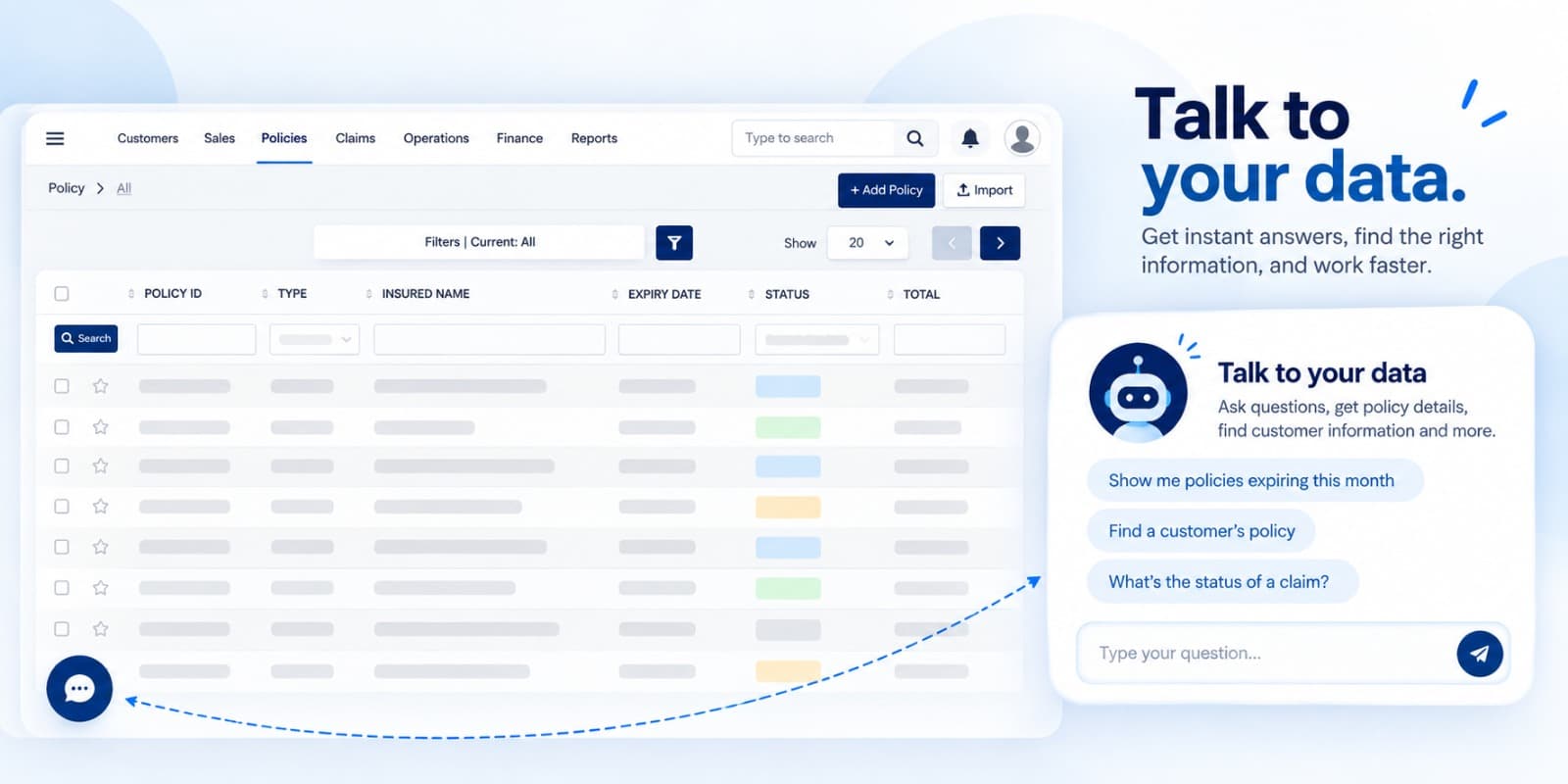
For a regional financial-services provider operating a heavily customized CRM platform with more than one hundred domain-specific modules, we designed and implemented the foundation for a production AI-assisted "conversational CRM" assistant. The business objective was simple: enable frontline and operations staff to answer day-to-day questions about customers, products, and activities in seconds, without navigating complex lists, filters, and detail views across multiple modules.
We began with discovery interviews and shadowing sessions across sales, service, and back-office teams. This surfaced a set of high-frequency questions (for example, recent customer interactions, policy status, pending tasks, and risk flags) and clarified strict data-access rules enforced by the existing role-based permissions model. In parallel, we assessed the current data model, integration patterns, and infrastructure to determine how a conversational layer could be introduced without replacing the underlying CRM.
Based on this, we produced an 18-month AI roadmap focused on "assisted insight" rather than full automation. The initial production release introduced a chat-based assistant embedded in the existing web portal, capable of translating natural-language questions into structured, permission-aware CRM queries. Subsequent capabilities expanded coverage across additional modules and introduced summarization and cross-record insights. Higher-risk actions, such as suggested updates and workflow triggers, were deliberately treated as later-stage capabilities, contingent on establishing the appropriate monitoring and human-in-the-loop controls.
Architecturally, we defined a layered pattern that separated concerns clearly: a conversational UI, an intent and query-structuring service, a metadata-driven layer that maps language to CRM entities and fields, a governed query engine that enforces access control and query safety, and a response composer that turns raw results into concise answers. This design allowed the client to reuse existing APIs and security mechanisms while introducing AI capabilities incrementally, with audit trails and rollback paths built into the architecture.
We then took the solution into production, initially focusing on a narrow but valuable workflow: finding and summarizing customer and policy records based on natural-language questions. The production system operates against live, access-controlled data, with observability built in so the client can understand how queries are interpreted, what data is accessed, and how responses are constructed. The implementation provided a practical foundation for expanding AI capabilities across the organization while maintaining the security, governance, and operational controls required in a financial-services environment.